Your child comes home from a Japanese school where every snack at the party had gelatin, lard or “pork extract” in it. What they want is something sweet they can actually eat. This is where Turkish snacks quietly became a staple in so many Muslim homes in Japan.
Turkey has a huge snack industry, most of its consumers are Muslim, and many of its brands print halal information on the pack. But “made in a Muslim country” is not the same as “halal certified”, so it pays to know how to read the label. Here is a thirty-second method.
Step 1: look for the certification logo
Most halal-certified snacks carry a logo on the back or side of the pack. The most common ones you will see on imported products:
- Turkey: a “Helal” logo (Turkish spelling), often from TSE or another certification body, sometimes with a certificate number.
- Indonesia: the Indonesian halal logo, previously the MUI green circle and now the purple national halal label.
- Malaysia: the JAKIM halal logo, widely recognised across Asia.
- Middle East and Pakistan: “Halal” printed in Arabic and English, often with the certifier’s name.
A certification logo from a recognised body is the strongest signal. If there is no logo, move to step two.
Step 2: check the ingredient that causes most problems
In sweets and biscuits, the usual problem is not meat. It is gelatin, which gives soft candies, marshmallows and some cream fillings their texture. On Turkish labels look for:
- Sığır jelatini: beef gelatin. Halal status depends on how the animal was slaughtered, so this is usually paired with a Helal logo.
- Domuz: pork. Avoid.
- Jelatin with no source: check for a logo or skip it.
- Bitkisel: plant-based. Pectin (pektin) and starch-based gummies avoid the gelatin question completely.
On English labels, the same rule applies: “bovine gelatin” or “halal gelatin” is a good sign; “gelatin” alone means you should look for certification.
Step 3: watch for alcohol and flavourings
Liqueur-filled chocolates are obvious. Less obvious are flavourings carried in alcohol. On Turkish packs, alkol means alcohol. On Japanese labels, look for 洋酒 (Western liquor) and アルコール.
Step 4: read the emulsifiers
Emulsifiers such as E471 (mono- and diglycerides of fatty acids) can come from plant or animal fat. On certified products the certifier has already checked this. On uncertified products, a plant-source note (for example “bitkisel kaynaklı” or “from vegetable origin”) answers the question.
Popular Turkish snacks on our shelves
These are the names our customers buy again and again. As always, check the current pack for the certification logo, because recipes and packaging change.
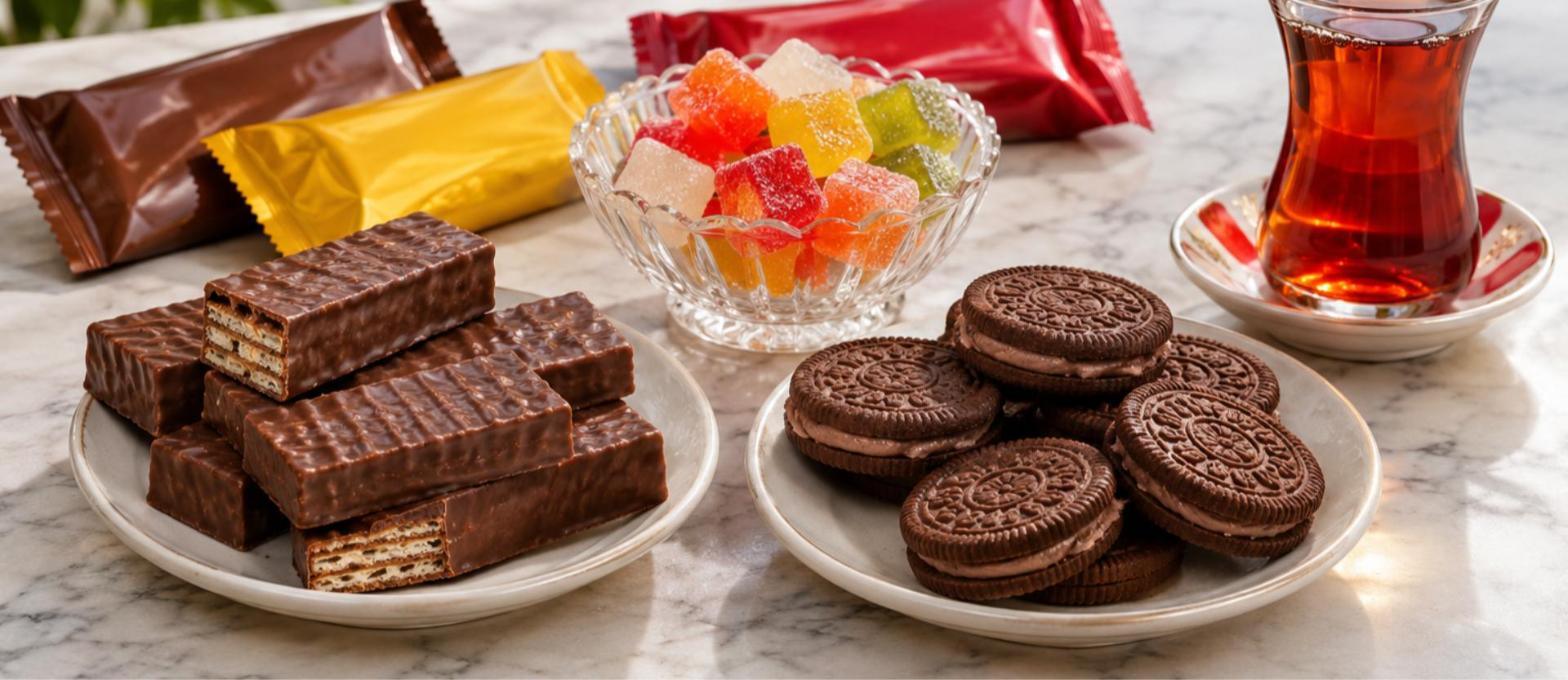
- Ülker Biskrem: cocoa biscuits with a chocolate cream centre. A lunchbox classic.
- Ülker Dido and Ülker Çikolatalı Gofret: chocolate-coated wafer bars.
- Ülker Albeni: chocolate, caramel and biscuit in one bar.
- Eti Çikolatalı Gofret: light, crispy chocolate wafer.
- Tayaş Damla soft candies in strawberry, lemon and an assorted fruit tub, great for sharing at school events.
See the full range in our Turkish collection, biscuits and cookies and chocolate sections.
A note for parents
Japanese schools are usually happy to help once they understand. Many families give the class teacher a short note explaining that their child does not eat pork, alcohol or gelatin from non-halal sources, and send a small pack of the child’s own snacks for parties and events. Keeping a box of individually wrapped bars at home makes this easy.
Beyond Turkey
Turkish brands are only part of the snack shelf. Indonesian, Malaysian, Thai and South Asian snacks are popular too, from chips and namkeen to wafers. Explore all snacks, namkeen and chips.
Thirty seconds at the back of the pack is all it takes. Fill the snack box with treats the whole family can enjoy.